

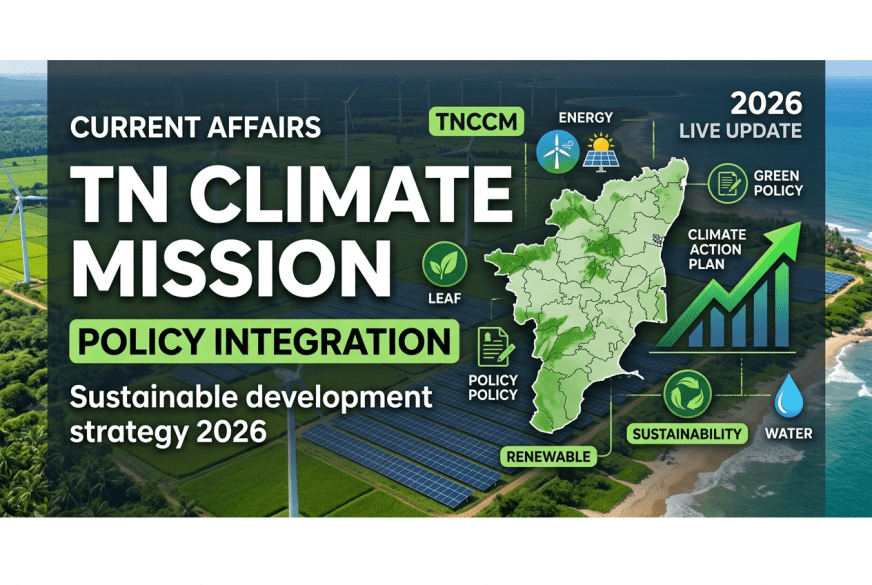
As of January 2026, the Tamil Nadu Climate Change Mission (TNCCM), meticulously executed under the specialized aegis of the Tamil Nadu Green Climate Company (TNGCC), has rapidly accelerated its aggressive environmental adaptation
And massive mitigation strategies across the entire state. Moving significantly beyond its initial baseline ecological studies and comprehensive greenhouse gas (GHG) inventories strictly established in 2023, the mission is now heavily focused on directly embedding highly advanced
Climate intelligence into all levels of district-level local governance. Following the aggressive initiation of comprehensive district-level climate action planning in 2024, the TNCCM has successfully scaled up highly crucial, on-ground tactical initiatives. These critical initiatives prominently include detailed, highly scientific urban cooling roadmaps, sophisticated real-time emission tracking digital systems, and innovative nature-based pilot programs specifically targeting carbon-neutral infrastructure development.
Key overarching operational goals aggressively pursued by the mission include rapidly transitioning high-emission industrial sectors to clean, completely renewable energy sources, passionately promoting sustainable public mobility solutions, and deliberately creating highly specialized climate innovation hubs that actively generate substantial green employment opportunities for the local youth.
By formally establishing and empowering dedicated Climate Cells directly at the district administrative level, the mission continuously empowers local communities and frontline bureaucrats to rapidly build long-term, robust resilience against increasingly extreme weather events. In the strict context of TNPSC examinations, this ongoing environmental mission is exceptionally relevant to syllabus topics covering Environmental Sustainability, Disaster Management, and State Ecological Policies.
Aspirants must absolutely note that Tamil Nadu is fiercely pioneering state-level climate action in India through completely distinct Special Purpose Vehicles (SPVs) like the TNGCC, making the TNCCM a highly probable subject for detailed policy-related questions. The specific integration of deeply scientific carbon neutrality goals with inclusive local economic development remains a primary focus for advanced policy evaluation.