

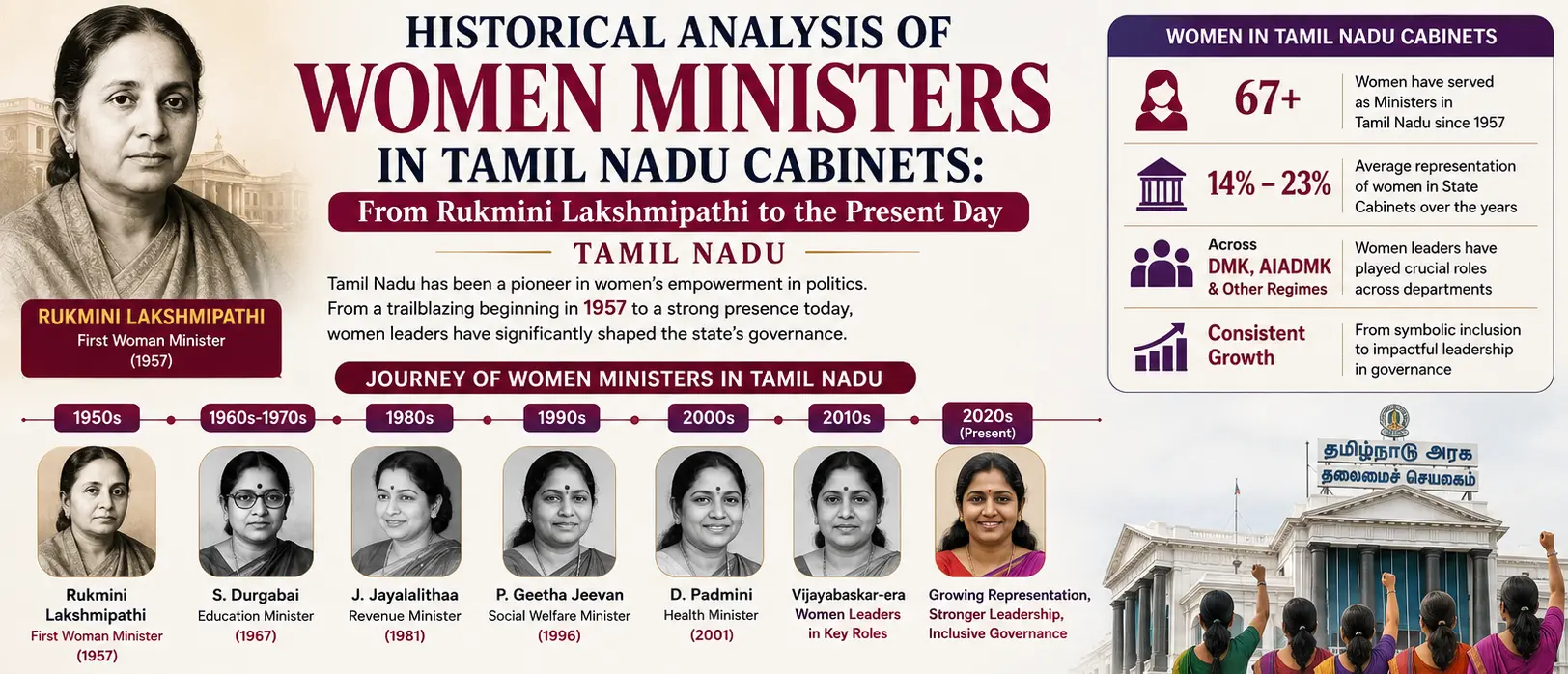
The Evolution of Gender Representation in the Tamil Nadu Executive
In light of recent cabinet formations, a historical review of women's representation in the Tamil Nadu Cabinet reveals a long evolution spanning from the pre-independence Madras Presidency to the modern era. While early cabinets frequently lacked women leaders, progressive inductions over the decades have established a continuous presence of women in the state executive.
Key Historical Milestones:
- The Pre-Independence Era: Following the 1937 elections held under the Government of India Act 1935, C. Rajagopalachari’s cabinet included no women. This administration resigned on October 30, 1939, after which Governor’s rule continued until April 30, 1946.
- First Woman Minister: Following the conclusion of the Second World War, a new Cabinet led by T. Prakasam assumed office on April 30, 1946. Celebrated freedom fighter Rukmini Lakshmipathi made history as the very first woman to be included in a Cabinet within the Madras Presidency, effectively managing the Public Health and Medicine portfolios. This Prakasam Cabinet lasted for approximately one year before resigning on March 23, 1947.
- Post-Independence Breakthroughs: After India officially became a Republic, no women were initially included in the Cabinet formed by C. Rajagopalachari on April 10, 1952, following the nation's first general elections. However, during a subsequent Cabinet reshuffle on October 9, 1953, Jothi Venkatachalam was successfully inducted alongside M. Bhakthavatchalam and K. Rajaram, serving as Minister until April 1954.
- Kamaraj Administration Updates: While no women were initially included in the subsequent Cabinet formed under K. Kamaraj, the political landscape shifted following the 1957 elections. On April 13, 1957, Lourd Ammal Simon broke barriers by being inducted as a Minister in his newly formed Cabinet.
- Dravidian Movement Milestones: When the Dravida Munnetra Kazhagam (DMK) formed the provincial government for the first time in 1967, Satyavani Muthu was appointed as the Adi Dravidar Welfare Minister in the Cabinet led by C. N. Annadurai. She later continued her ministerial service within the subsequent Cabinets of M. Karunanidhi.
- Chief Ministerial Representation: Following the passing of legendary leader M. G. Ramachandran, his widow Janaki Ramachandran briefly stepped into office as Chief Minister. Notably, she served as the sole woman present within that short-lived Cabinet.
- Continuous Modern Presence: Following the general elections of 1991, R. Indirakumari was inducted into the Cabinet formed by J. Jayalalithaa. Since this milestone appointment, women have continuously and uninterruptedly maintained active representation across all successive Cabinets in Tamil Nadu.
For TNPSC and Social Justice aspirants, tracing this legislative and political history is critical for answering trend-based questions in Indian Polity and the History of Tamil Nadu Administration.