

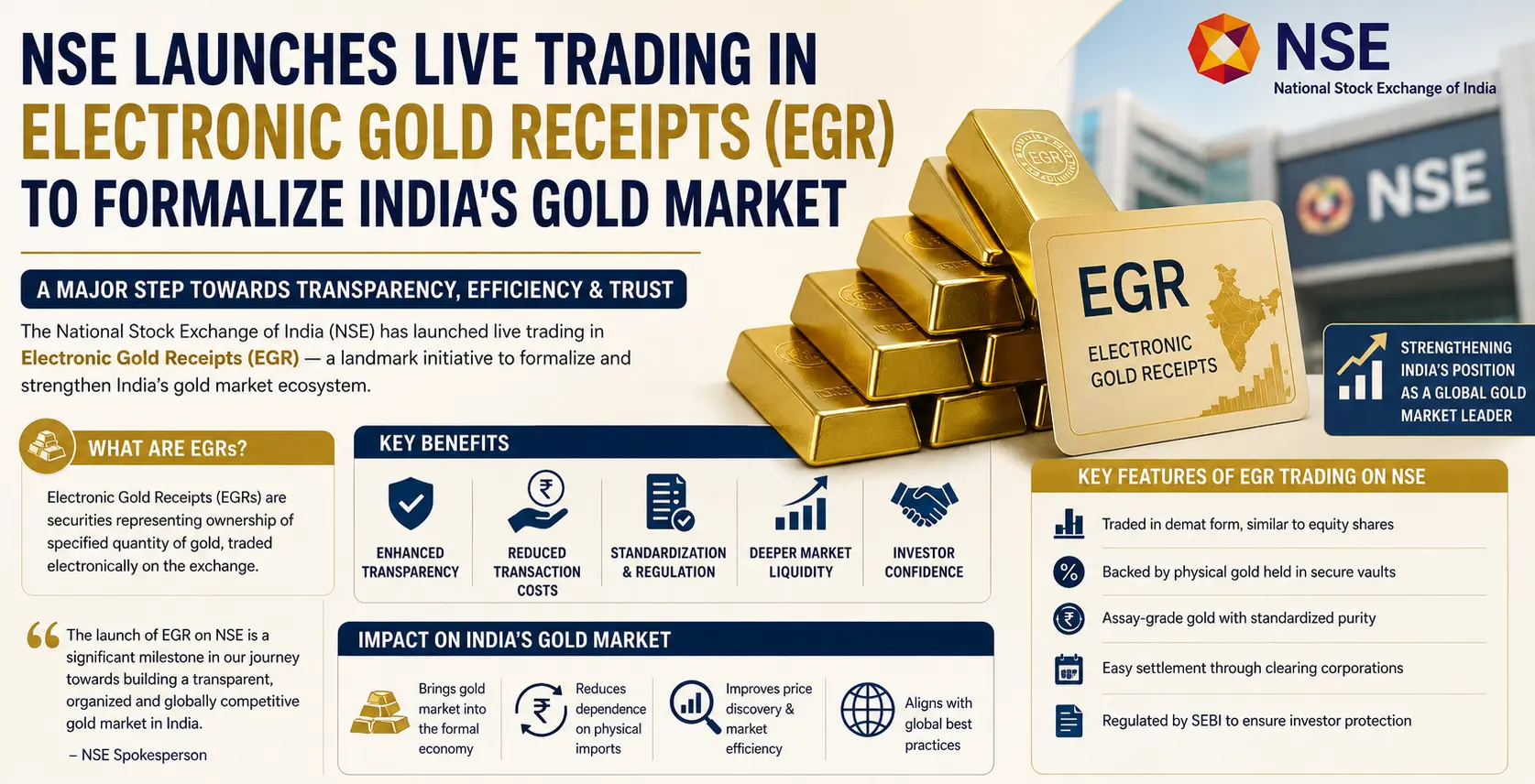
Financializing Precious Metal: NSE Introduces Regularized EGR Trading
In a major structural shift for India's capital markets, the National Stock Exchange (NSE) officially launched live trading in its newly approved Electronic Gold Receipts (EGR) segment on May 4, 2026, with full live volume rolling out smoothly by mid-May. This framework transitions physical gold into an exchange-traded financial instrument under the regulatory umbrella of the Securities and Exchange Board of India (SEBI).
Operational Framework and Denominations
EGRs act as dematerialized securities directly representing actual physical gold stored in SEBI-accredited vaults. To maximize financial inclusion and accommodate both retail and wholesale market participants, the NSE has introduced a versatile array of contract sizes across high purity standards (995 and 999 purity):
- Contract Variants: Available from institutional 1 Kilogram and 100-gram tokens down to highly accessible retail denominations of 10 grams, 1 gram, and even **100 milligrams**.
- Demat Architecture: The receipts are held electronically through standard NSDL or CDSL accounts, eliminating physical storage risks and locker fees.
- Market Mechanics: Operating on a standard T+1 settlement cycle, trading mirrors traditional equity sessions, continuing up to 11:30 PM or 11:55 PM (aligned with US daylight saving schedules).
---
Physical Delivery and Strategic Benefits
Unlike private, unregulated digital gold platforms that offer minimal investor recourse, the SEBI-backed EGR ecosystem features a transparent loop for physical conversion. Investors retain the dynamic right to surrender their electronic receipts and withdraw physical gold coins or bars from designated vaulting networks (initially active in major hubs like Ahmedabad and Mumbai, expanding to 120 centers nationwide). This conversion is executed upon paying applicable storage fees and a **3% Goods and Services Tax (GST)**.
For TNPSC, Banking, and SSC aspirants, this launch represents a core development under 'Indian Economy, Banking Reforms, and Financial Market Instruments'.