

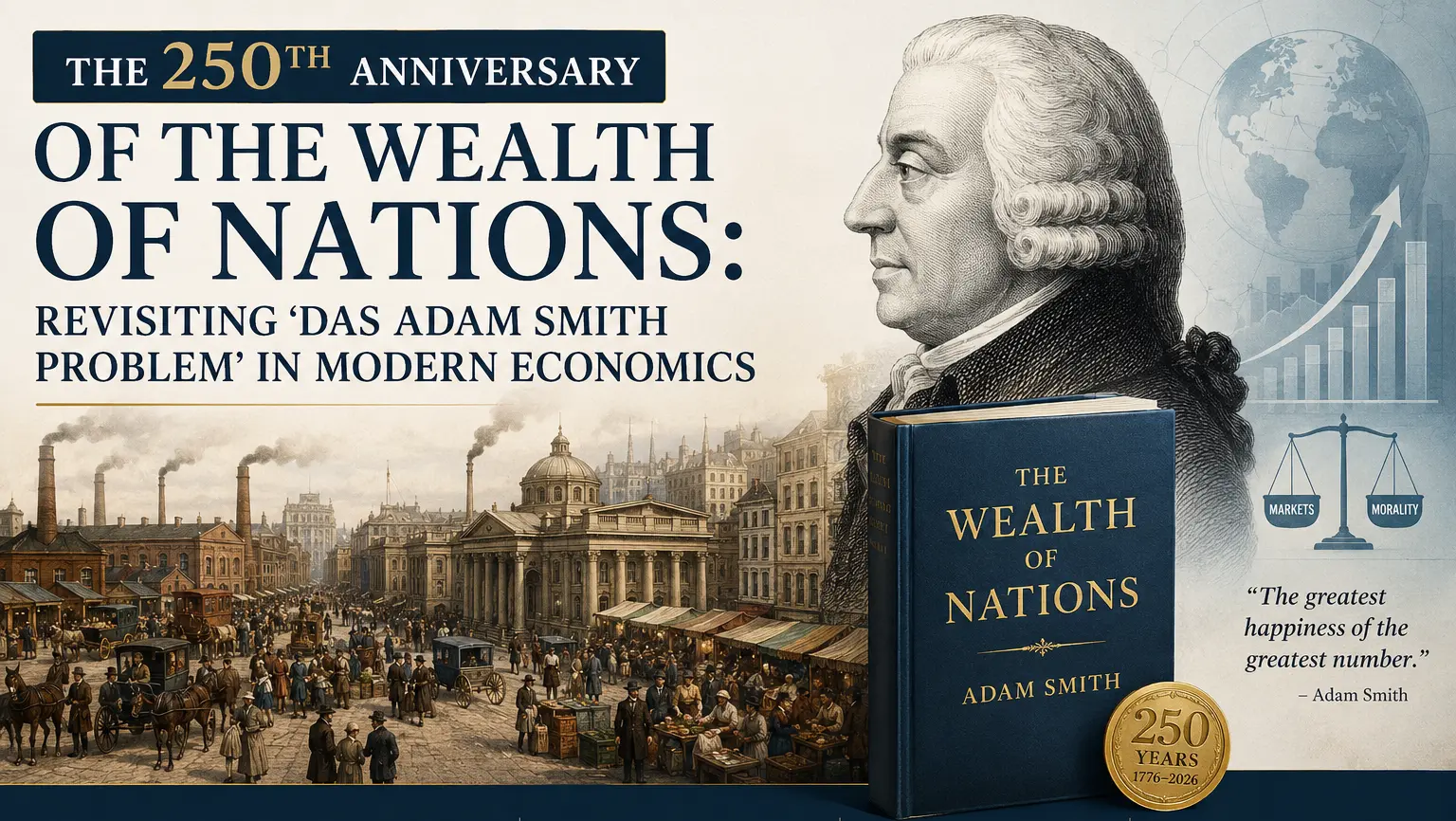
Re-evaluating the Foundations of Capitalism and Moral Philosophy
The global economic community is marking a monumental milestone with the 250th anniversary of Adam Smith's seminal work, The Wealth of Nations. This anniversary has significantly revived academic and political debates surrounding a long-standing intellectual dilemma known in economic thought as the “Das Adam Smith Problem”. Far from being a dry historical debate, this problem probes the very core of modern market mechanisms and corporate ethics.
Decoding 'Das Adam Smith Problem'
Originally coined by 19th-century German scholars, the term highlights a perceived, fundamental contradiction between Adam Smith's two core literary masterpieces:
- The Wealth of Nations (1776): Primarily emphasizes the driving force of self-interest, rational competition, and market efficiency as the engines of economic growth.
- The Theory of Moral Sentiments (1759): Focuses heavily on human morality, altruism, and the concept of moral sympathy as the foundations of an orderly, cooperative society.
---
The Modern Scholarly Consensus
While historical critics viewed these two philosophies as inherently conflicting, modern economic historians and social scientists strongly disagree. Contemporary analysis argues that Adam Smith never treated ethics and economics as isolated or opposing concepts. Instead, he seamlessly integrated them into a single, unified moral framework where markets cannot function sustainably without an underlying ethical fabric.
The Evolution of the Invisible Hand
At the center of this integration is the famous concept of the “Invisible Hand”. This mechanism illustrates how individuals pursuing their rational self-interest within a well-regulated market can inadvertently promote broader socially beneficial outcomes and collective welfare. In today's global economy, this balance serves as a vital blueprint for addressing corporate social responsibility, wealth inequality, and the ethical guardrails required in modern capitalism.
For TNPSC and UPSC Economy aspirants, understanding the philosophy behind Adam Smith's theories provides essential foundational knowledge for modules covering market structures, economic growth theories, and social welfare economics.